"Last Chance to Live as Indians! Last Chance Traditional Life!"

"Last Chance to Live as Indians! Last Chance Traditional Life!"

IMG4616-2 – The first little video below, is my favorite mini Battlefield Rose film of them all. This is after we’ve cruised way out on the plains, as she points out the places where the collective force of tribal people and warriors of The Battle of the Greasy Grass begin to build. “Last time we’re going to live as Indians! Last time the traditional life!” You can feel the Spirit of all of it. Aho Matakuye O’yasin! (All My Relations!)

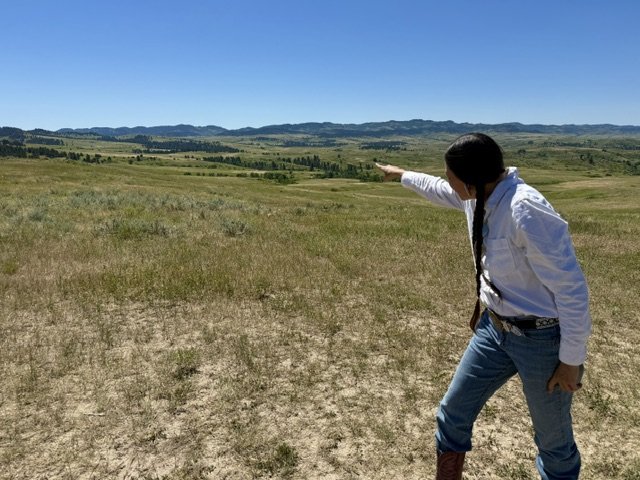
The next video, despite its brevity, is my second fav. It open with Rose’s infamous pointing finger, and when she states, “Over a twenty-year span of every battle site, I could take you to every battle site…” that finger becomes a barrage of pointy arrow fingers. So cool. At the same time she’s pointing out how The Greasy Grass camp grew, she’s also spotlighting the deception of the U.S. governments’ “federal numbers.”

The others highlight pre-LIBI history, the Cheyenne stealing General George Crook’s horses and sending him back to the forts that Winter. I’m obsessed with all this history currently, and especially figures like Two Stars, the name the natives gave General Cook. He wore a massive, untamed full beard, typical of 1876, which sat squarely in the Gilded age, the peak era for elaborate and heavy facial hair. Cook’s wild, wolf-like mane had the Apaches dubbing him Nantan Lupan, a respectful name translating to “Grey Wolf”. I was shocked to learn the Hostiles took down Two Stars at Last Stand Hill, as he died beside Custer, along with 266 other U.S. 7th Cavalry men, his “never-ending campaign until they’re done,” ending with him being done.

The final video is Rose at her best, pointing out Montana mountain ranges and laughing at :27 “You were sleeping at the bottom of the Bear Tooths and now you’re looking at the Wolf Tooths! Awesome!” Awesome indeed, setting the scene for the June 17th, 1876 Battle of the Rosebud just a week prior. I love how she describes Crook playing early morning cards, the soldiers “if they’re literate” writing letters to their sweethearts, and then the skirmish and the stories that follows. “And they’re sitting there talking about the old days when they used to fight,” as she finally draws attention to the fact that some government workers and Indian fighters found compassion for their enemies.  

I’m thinking there’s one more solid Rose post remaining as we approach the final battlefield. Then we’ll move on to our trip to Fort Buford, southwest of Williston, North Dakota, on July 19th, 2026, the very place where Sitting Bull came in from Canada and turned in his rifle, July 19th, 1881, along with a more in-depth look at the great Hunkpapa Lakota leader and Chief. Toksha
"Lakota! Lakota!! Lakota!!!"

"Lakota! Lakota!! Lakota!!!"

Hope you’re getting how cool Battlefield Rose is. Do you think we could roll down a dirt road or two, recounting the history & locales of the Indian Wars of America in 1876 and stay engaged? I think so. Sitting Bull’s bid to stay 100% free of reservation life, not relying on the whites for coffee or sugar, was clearly celebrated by his people. Yet, the wasichus, the white settlers, and especially the great white Chief in Washington, clearly had a different take.

Rose pointed to the horizon often, citing where mountain ranges came together, where Custer split from Benteen, and where each of the columns of soldiers originated in their Spring 1876 mission to push the remaining “Hostiles” onto the reservations. It all kicks off when Two Stars, General George Cook, attacks a sleepy Cheyenne camp along the Powder River on March 17th. Red Cloud, the venerated Oglala Chief, fought for years along with the Cheyenne and Arapaho to protect the tribal hunting grounds along the Bozeman trail. Red Cloud established the Lakotas as the only nation to ever defeat the United States of America on its own soil. But that was a decade before, 1868-1868, with Red Cloud at this point on the reservation, soon attending Catholic Mass, peace be with him & his relatives.

There are deffo some esoteric LIBI points weaved into these videos, one being the Lone Tipi. This deserted frame contained the burial scaffold of a Sans Arc Lakota warrior, Old She-Bear, from the earlier Battle of the Rosebud, on June 17th. Custer paused here to give Major Marcus Reno his final orders to advance and attack the Indian village. I like how Rose points out, with her fingers, how facts and truths may or may not fall together. More on the Native people of the Americas living their best, traditional life soon. In the meantime, come on out this weekend for the very same Ceremonial purification ritual they practiced with regularity. If not, we’ll see you in October, November, or December. Aho Matakuye O’yasin! (We’re related)

Roses of The Lil' Big Horn Battlefield

Roses of The Lil' Big Horn Battlefield

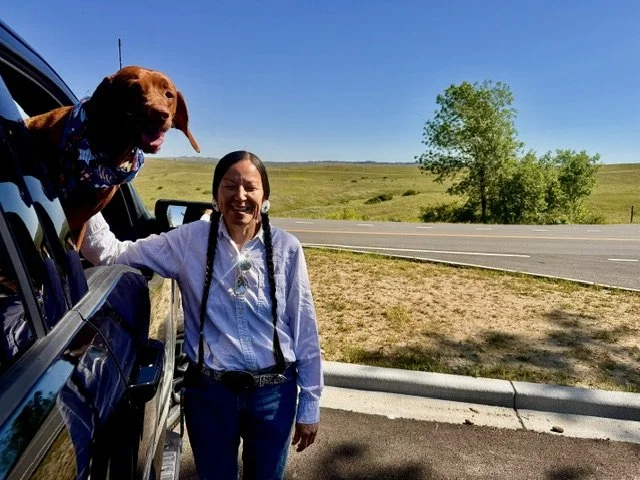
I drove all the way into town to the South haven library on my sorta day off because we’re Michigan Hillbillies with purposeful bad service. Anyhoot, hoot, hoot, I’m so happy and inspired, introducing you all to Olivia Rose Williamson, with so much more to say, turning it over for now to Rose’s engaging Native knowledge and energy.

This was my first encounter with her, as we met at the monument on an equally scorching hot Montana summer Sunday morn, and took our tour, beginning and ending at Last Stand Hill. I loved the way she described her peoples’ history and luck getting a reservation on their traditional land. “When the Black Hills end, Crow Country begins. When Yellowstone Park ends, Crow Country ends.” Right on Rose. A very cool, capable Guide. More soon!