
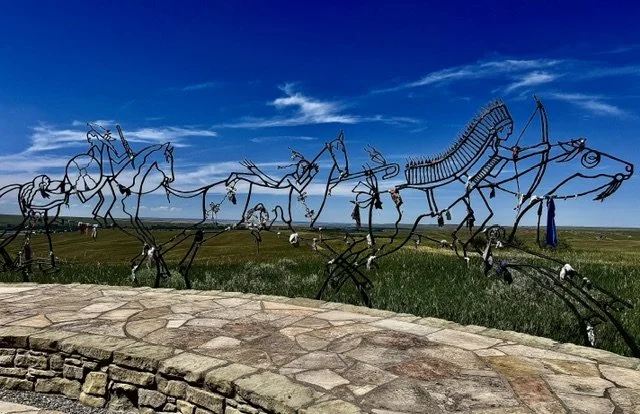
IMG4616-2 – The first little video below, is my favorite mini Battlefield Rose film of them all. This is after we’ve cruised way out on the plains, as she points out the places where the collective force of tribal people and warriors of The Battle of the Greasy Grass begin to build. “Last time we’re going to live as Indians! Last time the traditional life!” You can feel the Spirit of all of it. Aho Matakuye O’yasin! (All My Relations!)
The next video, despite its brevity, is my second fav. It open with Rose’s infamous pointing finger, and when she states, “Over a twenty-year span of every battle site, I could take you to every battle site…” that finger becomes a barrage of pointy arrow fingers. So cool. At the same time she’s pointing out how The Greasy Grass camp grew, she’s also spotlighting the deception of the U.S. governments’ “federal numbers.”
The others highlight pre-LIBI history, the Cheyenne stealing General George Crook’s horses and sending him back to the forts that Winter. I’m obsessed with all this history currently, and especially figures like Two Stars, the name the natives gave General Cook. He wore a massive, untamed full beard, typical of 1876, which sat squarely in the Gilded age, the peak era for elaborate and heavy facial hair. Cook’s wild, wolf-like mane had the Apaches dubbing him Nantan Lupan, a respectful name translating to “Grey Wolf”. I was shocked to learn the Hostiles took down Two Stars at Last Stand Hill, as he died beside Custer, along with 266 other U.S. 7th Cavalry men, his “never-ending campaign until they’re done,” ending with him being done.
The final video is Rose at her best, pointing out Montana mountain ranges and laughing at :27 “You were sleeping at the bottom of the Bear Tooths and now you’re looking at the Wolf Tooths! Awesome!” Awesome indeed, setting the scene for the June 17th, 1876 Battle of the Rosebud just a week prior. I love how she describes Crook playing early morning cards, the soldiers “if they’re literate” writing letters to their sweethearts, and then the skirmish and the stories that follows. “And they’re sitting there talking about the old days when they used to fight,” as she finally draws attention to the fact that some government workers and Indian fighters found compassion for their enemies.
I’m thinking there’s one more solid Rose post remaining as we approach the final battlefield. Then we’ll move on to our trip to Fort Buford, southwest of Williston, North Dakota, on July 19th, 2026, the very place where Sitting Bull came in from Canada and turned in his rifle, July 19th, 1881, along with a more in-depth look at the great Hunkpapa Lakota leader and Chief. Toksha