Our November Retreat

Garun, Tayler, Sebastian, Sam, Caroline, Mimi and Sara grace The Wall of Wisdom.

Garun, Tayler, Sebastian, Sam, Caroline, Mimi and Sara grace The Wall of Wisdom.

Wouldn’t it be wonderful if a weekend away could actually return you to yourself? With a focus on Meditation, Prayer, Ceremony, health and well-being, a visit to The Higher Haven can, and does, just that. There’s a womb that lies underneath our world to which one day our bodies will all return. But if you make a choice to go there while you’re still alive and well - or at least working on it - you can be reborn. We’ll keep the power of the Make-Your-Life Ceremony a bit of a Mystery, as it should be, the kind you need to experience. That’s the inner journey that myself and Yoga Teacher Samantha Jameson went on with Caroline, Garun, Mimi, Sara, Sebastian, and Tayler, with the venerable Scott Campbell helping to navigate the rocky Way.  These are practices that are in the spirit of the teachings of Eckhart Tolle, when he says one must “die before they die” in order to awaken to a new life. In the words of my own meditation teacher Shinzen Young: “when we bring enough concentration, relaxation and equanimity to our ordinary experience, our ordinary experience ceases to be ordinary or even material, and we have a direct experience of the Spiritual Nature of ourselves and all of creation.” If that sounds like something that could be of interest to you, our final weekend of spiritual purification - this particular retreat using colorful and creative mind-training techniques of the indigenous people of the North American Plains - happens here Saturday December 8th to Sunday December 9th. We look forward to seeing you to begin our Winter Serene Season. Toksha Ake

Cochise County Arizona

Cochise County Arizona

AZC.jpg

Well, the night was falling as the desert world
Began to settle down…
In the town they're searching for us everywhere
But we never will be found…

Paul McCartney’s 1970’s ode to freedom and escape booms from the mobile receiver on the 120-mile drive from Phoenix to Tucson, a two hour stretch of austere desert wilderness. This desolate tract inspires and always has, calling to mind the old Paul Shephard quote, a great passage on a great passage, recognizing the desert as “an environment of revelation, genetically and physiologically alien, seriously austere, esthetically abstract, historically inimical… “ As to forms bold and suggestive, sparkling rock boulders dot the landscape against a backdrop of craggy mountain lines etched against a pure azure sky. Sagauro cacti wicket past my rattling rental car, the large, looming, ruling royal family class of desert plant life being one of the finer example of trees the Lakota people are fond of calling The Standing People. This upstanding flora family and arborescent species grows to be over 40 feet tall and lives to be 150 years old, green-gray figures indelibly linked to the American South West.

“…To the deserts go prophets and hermits; through deserts go pilgrims and exiles. Here the leaders of the great religions have sought the therapeutic and spiritual values of retreat, not to escape but to find reality”, concludes Shephard. The scholarly, serious take on life as a desert rat is a nice juxtapose with more breezy radio commentary like the now jamming opening chords to the Beatles Get Back, Sir Paul noting that “Jo Jo left his home in Tucson, Arizona for some California grass.” I read that McCartney has a hidden ranch someone near Tucson, and a quick online search now reveals that Paul purchased 151 acres near the Tanque Verde River in the foothills of the Rincon Mountains, northeast of Tucson in 1979. Linda Eastman attended the University of Arizona, where she studied art history and developed an interest in photography.

Good for the McCartneys, as the unknowing, non-local and majority of people who aren’t ex-Beatles will not head to the south east on the 17 out of Phoenix, but rather to the boring north, up to the supposed magical red rock area around Sedona. But if you really know your way around Arizona — and I’m happy to say I do, having resided there from 1998-2006— you’ll take the I-10 south to Tucson and past to Texas Canyon, out to the east and well beyond. There the old stagecoach route of the Butterfield Overland Mail passed through until the Civil War’s outbreak in 1862, when the stage line suspended operations. The canyon stands historically within the range of the Chiracahua Apache and their leader, the brilliant military strategist Cochise.

Here he made his stronghold in the Dragoon Mountains, a rough woodland area that lies like a protective rampart of granite domes and sheer cliffs, once the refuge of his people. Upon his death, Chochise was buried somewhere in or near this impregnable stone fortress, the exact location having never been revealed or determined. Not far from this spot is Apache Pass and Fort Bowie, the US Army’s 19th-century outpost. Geronimo, another Apache leader and legend of the untamed American frontier, rode these trails as well. A naturally gifted hunter, the story goes that as a boy he swallowed the heart of his first kill to ensure a life of success on the chase. Being on the run certainly defined Geronimo’s way of life. As a member of the Bedonkohe, the smallest band within the Chiracahua tribe, Apaches were surrounded by enemies. Not only Mexicans, but other tribes including the Diné or Navajos and Comanches.

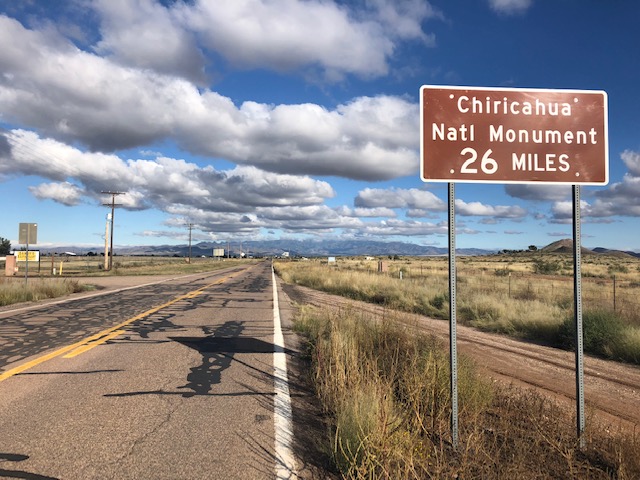
Cut into this austere country are the rough roads these warrior-chiefs rode and ran on their way to distinction. While their world was snatched away piecemeal by parcel-grabbing settlers, miners and others, these brave leaders worked in battle and in peace to protect their land, their people and their way of life. Hardship and a hard land helped form their superior character, just as Jesus, too, was led into the desert wilderness to fast for 40 days and nights, facing his demons and passing the devil’s tests. We’ll be back in Cochise County and Chiracahua National Monument’s Wonderland of Rocks with some new travelogues right after Christmas. And we’ll close with an excerpt from Reiner Maria Rilke’s poem The Man Watching, another great take on the desert and the power of demon brawling.

 What is extraordinary and eternal
does not want to be bent by us.  
I mean the Angel who appeared
to the wrestlers of the Old Testament: 
when the wrestlers' sinews  
grew long like metal strings,  
he felt them under his fingers  
like chords of deep music.

Whoever was beaten by this Angel  
(who often simply declined the fight)  
went away proud and strengthened 
and great from that harsh hand,  
that kneaded him as if to change his shape.  
Winning does not tempt that man.  
This is how he grows: by being defeated, decisively,  
by constantly greater beings.

Our Kinship with Mongolian Eagle Hunters

Wambli (Eagle) Feathers used for Ceremonial Healing and Purification

Wambli (Eagle) Feathers used for Ceremonial Healing and Purification

I started this article previously by stating : “The previous post’s power outage lead to a curious confluence of recent events.” In retrospect, it’s not all that curious: I simply don’t turn the TV on very often, so blown power and no heat prompted a Sunday night at a buddy’s house, ironically catching the television newsmagazine 60 Minutes. That show’s piece of interest focused on Lauren McGough, an American woman from Oklahoma whose become one of Mongolia’s finest Eagle Hunters. The story began in the Mongolian province of Bayan-Ölgii, where Asia China Russia and Kazikstan meet. There, a group of nomads live the lives of 19th century ranchers, Cossacks who make up only 4% of Mongolia’s population, surviving on meat and milk and burning dung for fuel, all the while existing without running water and electricity, that last piece certainly gaining my attention.

Falconry - the ancient art of hunting with birds of prey - was born in this forbidding land, the Altai mountains of central Asia Mongolia. Hunters still loft Golden Eagles into the sky in a partnership of man and bird that that pre-dates recorded history. “This is where it all began it’s the cradle,” said McGough. “Several thousand years ago, we don’t know exactly when, a man saw a Golden Eagle catch a rabbit or a fox and had the ingenious idea to hunt in partnership with it. It blows my mind that’s its even real. It’s like something out of The Lord of the Rings, but you can do it.”

The Mongolian Steppe is the greatest expanse of grassland unaltered by human influence. It endures because human existence has narrow odds between the widest climate extremes on earth -  104 degrees in summer, 50 below in winter. (I was Ulaanbaatar-bound - the capital of Mongolia - in January at the start of this piece until they detailed that winter low). Nomads depend on the animals that yield nearly all of their food fiber clothing and fuel. And one of the oldest bonds in nature is an alliance of survival among hunters, horses, and Golden Eagles. The birds are abundant all around the Northern Hemisphere. In terms of survival as a species, conservationists call Golden Eagles an Animal of Least Concern.  It’s a ten-pound animal but as McGough pointed out, don’t be fooled if that doesn’t seem like a lot. “They have hollow bones and are mostly feathers,” she said. “Ten pounds on a bird is an enormous bird. They have a six foot wing span with lovely amber eyes, the name Golden Eagle derived from the lovely feathers they have on their nape, around the neck. They’re quite effective at killing, which is what they’re built for, they are modern day Velociraptor. a perfect product of evolution. I will never be tired of watching a Golden Eagle in flight; every single time I see it, it thrills me.” When I heard that statement, i thought: That’s exactly how I feel about running Ceremony. It’s an endeavor connected to the natural world that will never cease to cause me delight.

Once in the nomad camp, the indigenous culture’s warmth was evident, despite the harsh conditions. “These are the people that can talk to animals, because they have relationships with goats, sheep, horses, camels and eagles,” said McGough. They have intimate knowledge of where snow leopards and foxes are. There’s no agriculture there because the land is unworkable. These people ingeniously learned to work with domestic animals and build these unique relationships with wild animals.” The story closed on a young boy named Bekka, introduced as the hope of his family’s traditional world. He’s learning horsemanship and falconry, and in Bekka 60 minutes discovered the most endangered species of the steppe — the nomads themselves. In our world there may be only 300 eagle hunters left, a rare breed of human still speaking the language of the wild.