Rumble: The Indians Who Rocked The World

JimmyH.jpg

I caught a rocking little documentary film last week, the latest exhibit springing from Tomorrow’s Stories, our local art centers’ Fall show of contemporary Native American artwork introduced in the previous post. Rumble – The Indians Who Rocked The World –  exposes a virtually unknown element of American musical history, that of the influence of indigenous artists on jazz, the blues, and the worldwide rise of rock and roll. Iggy Pop, Martin Scorsese, Steven Tyler, Robbie Robertson, Slash and a host of others circle up to shine a light on the origins of our country's sonic backstory, citing the African polyrhythms mixed with Native chants that created the very fabric of the sound that later became American Popular Music.

From the opening roar of Shawnee guitarist Link Ray’s Rumble, the movie flows like a river across many a rez, carrying viewers along by the surprise of its own unfolding and winning a Sundance Special Jury Award for Masterful Storytelling. Morning songs, songs of the old way, songs of freedom and of the people were outlawed with the coming of the Wasichus (Whites) as the film traces the banning of native music all the way back to the Wounded Knee massacre of 1890. Laying low revolts like the Ghost Dance lead by Pauite Medicine Man Wovolka - movements that threatened the new white reality and were thus censored and oppressed - set the stage for the rebel spirit of rock and roll. “It may not have sounded like it, but that was the beginning of the blues,” said Cyril Neville of New Orleans’ Neville Brothers.

Indigenous singers identified the drum as an instrument of insurrection, stating that “With a drum you can send coded messages, gather people, spark a revolution.” Several Uncis (Grandmas) played the role of positive, artistic influences, from Jimmy Hendrix’s paternal Nanna, Zenora "Nora" Rose Moore of Cherokee descent on up to the Shoshone background of The Black Eyed Peas’ rapper Taboo. I was also happily turned onto to figures like Charley Patton, pioneer of the delta blues of Choctaw ancestry as well as the writings of John Trudell, who I only knew previously as a political activist and one of the leaders of the American Indian Movement (A.I.M). Also an Author, poet, actor, and musician, on his deathbed Trudell uttered his final verses, saying, “My ride showed up. Celebrate love. Celebrate life.”

Researching for this write-up revealed the central reason for the film’s engaging creative take, brought to light in after commentary by Native musician and executive producer Stevie Salas. Salas makes the important point that the filmmakers were adamant to tackle the hard part of making a movie about heroes who did amazing things, not a victim film expressing, ‘I’m an Indian and you really screwed us over again’. “We didn’t want to do that,” he said. “We wanted to celebrate these artists and what they achieved, many against all odds. If you want to lean on the negative it’s there, you can, but why put the emphasis there? The film shows you some of the beauty, some of the culture, lets you feel some of the pain of the past but not lean on the pain like a crutch. It’s a tough dance to do. The story was respectful, educational and entertaining.” Aho Good one. 
Tomorrow's Stories

BEADKINI.JPG

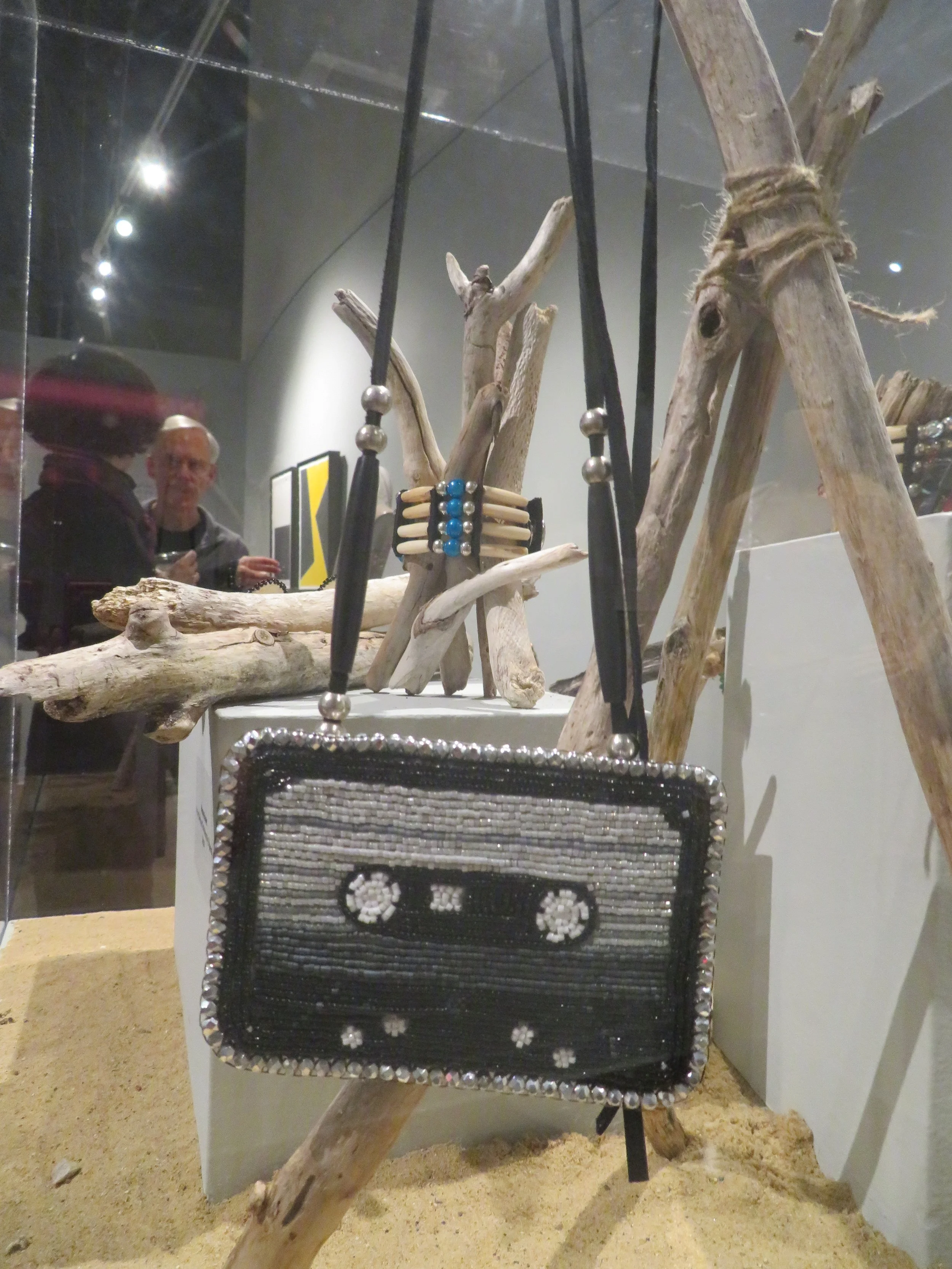
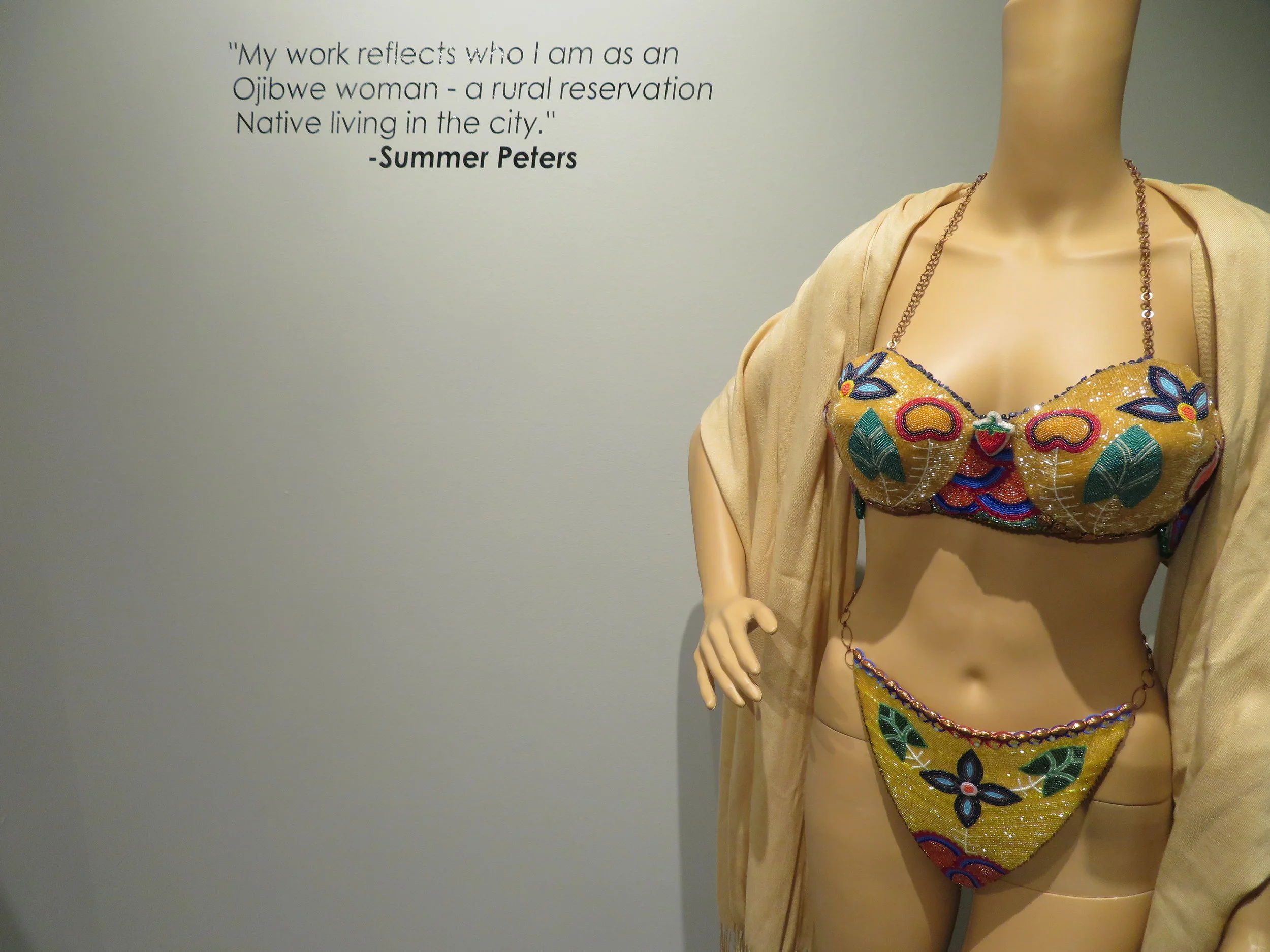
Behold the beaded bikini, one of several noteworthy pieces telling a modern tale of contemporary Native American Art exhibited in the current Southwest Michigan show titled Tomorrow's Stories. Brought to our community by the local  hub of higher creativity, The Saugatuck Center for the Arts, the show displays two and three-dimensional works by five celebrated Native artists, including the pictured piece - or perhaps two-piece - from Summer Peter's Beyond Buckskin Fashions. In a number of mediums, from baskets to sculpture to wearable and decorative items, creators offer a fresh perspective of what Traditional Native American Art was and is. Peter's calls the beaded beachwear  "Decolonize Your Glitch", envisioning "women of all sizes being able to be comfortable in their skin and unashamed" when she created it. 

Recognizing native concepts everywhere in popular American culture, from local and organic food, fashion, art, design, alternative medicine, holistic health, “going green”, and even gentrification - the artists reinterpret the modern indigenous experience, breaking out of boxes built by the traditions of yesterday, and contributing to the conversation of moving contemporary art forward. " I believe that all of American Contemporary Art is based on Traditional Native American concepts, motifs, sensibilities, and aesthetics - starting with the Land, " writes Guest Curator Dakota Shayne, "Original colonizers of America arrived on the shoreline describing indigenous peoples as primitive and uncivilized, but that perception may or may not be accurate. If we take a fresh look, with an open mind, we may discover that this new world called America was actually a concept of life and way of thinking that colonizers never experienced before. This new world was full of Spirit, expression, design, organic farming, environmentalism and tolerance. From that perspective, the traditional Native American doesn't seem primitive - but actually contemporary."

I was honored to join this small circle of indigenous modernism early Saturday morning with a group from the SCA, visiting Jason Quigno's Grand Rapids studio. The sculptor, of Saginaw Chippewa descent, works in a cool, dust laden, green-grey art cavern with vital stone forms drawing from Ceremony and tradition. "My people, our culture, and the way we exist as a tribe in the modern world continues to evolve; it is not static, " says Quigno. "Our stories and traditions remain vibrant, and my art work is a means by which I can express my gratitude and love of this good life." The Fall show runs through early November, with community and education outreach, a fashion event, and a showing of the Sundance Film Festival winner RUMBLE: The Indians Who Rocked The World, an acclaimed feature documentary about the role of Native Americans in popular music history.

IMG_6784.jpg

Go ahead and hate your neighbor
Go ahead and cheat a friend
Do it in the name of Heaven
You can justify it in the end
There won't be any trumpets blowing
Come the judgment day
On the bloody morning after
One tin soldier rides away 

-The Legend of Billy Jack 

Soul Pose(R)

TABLE.jpg

Soul Pose came through Michigan and more accurately Grand Rapids last week, one of several towns on the traveling Yoga events' Fall tour of cities including Los Angeles, Austin, and Montreal, QC. Dubbed The Happiest Yoga on the Planet, "the laid-back, no-pressure environment" gathers together all-level practitioners for several blacklight yoga classes throughout the day, employing body paint, confetti and a fun community experience. I rented a space outside the conference hall/yoga studio a bit last minute, as the Western Michigan yogini crowd definitely fit the retreat center profile. ArtPrize is also on, the open, independently organized international art competition with pieces exhibited every Fall for 19 days throughout downtown GR — in museums, parks, on bridges and in vacant storefronts.

Speaking of vacant storefronts, the day was certainly an experience. After each class, a river of event attendees - mostly females sparkling in neon paint and the post-class afterglow - flowed into the hall en route for the La Croix water stand and other booths. To paraphrase writer Ramon Carver, I'd then put on my best smile. Then I held it. I held it until I felt my face pulling out of shape. That makes me laugh out loud as I write this, however, at the time - not so funny. Usually the experience of promoting my place is extremely upbeat, with feelings of gratitude coupled with the positive service vibe. But sometimes hocking The Higher Haven feels completely dispiriting, offering me a whole new unforeseen vista of crummy emotions. 

My own sensitivities considered, I'm always happy for having developed some degree of meditative skills. I'll joke now that these abilities allowed me to feel my own self-loathing with enhanced precision. But as my meditation teacher Shinzen explains, part of the problematic nature of the homo sapien is continuously having incomplete experiences. "If you have a complete experience of depression, or even of buttoning your shirt, you could become enlightened spontaneously", he half-jokes. When we open ourselves up to this fullness of feeling, turning toward rather than away from pain, especially of mind-states we find distasteful, things tend to harden less and shake loose more. This action I've heard referred to as Leaning Into The Sharp Points.

Making this very motion, one of stillness but a shift in awareness, relaxing in the center of my fear and discomfort, helped everything quickly right itself. I most likely crossed paths with folks I was meant to, made contacts, had some laughs, and even jumped into the 2:30 class. Near the close, one person lingered, looking over the wild flowers and Hanblecha blanket that made up my sacred lil' space and said, "I'm not sure exactly what that is over there, but it sure looks peaceful."  That was a great reminder that we possess knowledge and creativity here that is very rare and currently very relevant to the human condition. With a bit more perseverance, patience and time, we'll continue to act our dreams with open eyes, making all things possible. 

SOULPOSEYEZ.jpg