Indiana ~ The Crossroads of America

The Hoosier state, The Crossroads of America, the "Indian Land" otherwise known as the 36,418 square miles demarcated as the great state of Indiana called us out for a mini-road trip over the 4th of July Holiday weekend. A group of Indiana University grads visiting Michigan recently turned me on to the original offerings of the Bloomington/Nashville area in the state’s southern region. Most of Indiana consists of flat lands with soil composed of glacial sands, gravel and clay,  exceptional farmland being the result. The state’s unglaciated southern segment carries a different, off-balance surface, characterized in places by profound valleys and rugged, hilly terrain; with limestone prevalent, numerous caves mark the area. But more than just soil and landscape sets the space apart. While Michigan’s poisonous reptile population begins and ends with one snake, the elusive Eastern Massasauga or “Swamp rattler”, southern Indiana’s reptile species include Five-Lined Skinks and bright pink Copperheads. Their stand-out specimen is the Timber Rattlesnake, the local that inspired a 280 mile, 5-hour one-way drive in hopes of catching a rare glimpse of its gorgeous, cross-banded yellow-green pattern.

Minus the drive time, I had all of twenty-four hours to visit. Add the crush of unaccounted for State Park occupancy on a 4th of July weekend, and my chances of crossing paths with a rattlesnake were quickly slithering away. What I needed was a contact, someone who knew the trails and could help negotiate the lay of the land. A quick search presented Indigo Birding Tours, led by naturalist  David Rupp. David arranged birding excursions and other south-central Indiana trips to some of the areas’ most sought-after, natural attractions, in Brown County State Park, Yellowwood State Forest, and Goose Pond Fish and Wildlife area, a migratory area birders went wild over. Ringing him up, I explained to David that I was more after scales than feathers, knowing a rattlesnake sighting was a long-shot given their secretive nature. While he concurred, acknowledging he'd spotted all of two Timber Rattlers in all of his years working the Indiana woods, he did know of a few snake-friendly spots, as well as a few choice trails given my limited time. We arranged to meet up, hit a rugged five-miler together, and from there he'd point me towards a few other spots, passing on some good maps to get me there.  

The etymology of the word “Hooiser” is disputed, but the leading theory, as advanced by the Indiana Historical Society, is that the term originated from the Carolinas as an idiom for a backwoodsman, a rough countryman, or country bumpkin. David was none of these, as the Benjamin ($100) I paid him to usher me into the flora, fauna and history of this new and exotic area of the Midwest was well spent. While calling in Scarlet Tanagers and Hooded Warblers, he pointed out The White-Breasted Nut Hatch and Eastern Towhees. Offering up a background on both the area’s animal and human inhabitants, David explained that varying cultures of indigenous peoples and historic Native Americans inhabited Indiana for thousands of years. Paleo-Indians led to the Archaic and then Woodland Periods; an early Woodland period group named the Adena people held elegant burial rituals, featuring log tombs beneath earth mounds, while other groups had large public areas such as plazas and platform mounds where leaders lived or conducted rituals. The historic Native American tribes in the area at the time of European encounter spoke different languages of the Algonquian family. They included the ShawneeMiami, and Illini. Later they were joined by refugee tribes from eastern regions including the Delaware who later settled in the White and Whitewater River Valleys.

Exploring the history and natural surroundings of one's Homeland always ranks high of my list or valued activities. But even since returning to the Midwest seven years ago, travel and road tripping are in the back seat to building up the foundation for The Higher Haven. Looking back on several significant moves in my first 50 years, I'm always reminded of the take of poet Robert Bly, who said, "If one does not become a place after living there for a few years, then one must move on." I've become some places - The Sonoran Desert - while others I have not - The Bay Area - knowing every reality has its own lessons, and when lessons are learned, the journey continues. Considering I'm not going anywhere on one level for about a decade, I'm hoping to take Bly's thought a stride further, aiming  to  elevate my current reality - Property #  03-02-0023-008, South Haven, Michigan - to evolve parallel with my personal growth.  With more rooted goals in mind, getting on the road again and goin' places that I've never been, seein' things that I may never see again felt damn good. Nothing beats a five hour drive coupled with a seven mile hike followed by a thorough overview of the bistros and breweries of a town like Bloomington. To boot, we DID see a Timbler Rattler, albeit a culprit tubbed by a DNR officer after terrorizing a camp ground bathroom. And birding with a guide gave me a new awareness of the winged endothermic vertebrates soaring about, spotting North America's largest Pelated Woodpeckers and enjoying a final exchange with a young Red Tail Hawk on the IU campus. Here's to navigating multiple altitudes with more wild Midwest adventures to come. 

HAWK1.JPG

Edward Sheriff Curtis ~ Shadow Catcher Exhibit

Slightly extended summer light and weekends offer a chance to meander up the Lake Michigan coast, with an eye out for funky little places like Muskegon, an old industrial port town on the transition. Just when you might think Chicago’s two-hour ride is the only hub for high cultural excursions, the Art Coast surprises you, in the form of a summer showing of Edward S. Curtis: The North American Indian. The Muskegon Museum of Art displays 723 portfolio photographs of more than eighty North American tribes through September, a comprehensive critical exploration of the early-1900s photographers work and celebrated 30-year study of Native American life. We’ve sat with Ed Sheriff Curtis previously, in an earlier article with an automatic focus on his picture of a Kutenai first nations reed harvester, appearing over the stone hearth of my brother’s northern Michigan homestead in the Winter ‘16. (1916 - or so it appeared). With an early openness to Native thought and culture, Curtis’s determined quest to capture a “vanishing race” significantly influenced how 20th century Americans viewed Indians.

As stated, before being dubbed Shadow Catcher by the tribal people of America, Edward Sheriff Curtis was born the son of an impoverished itinerant preacher and farm wife in 1868 near White Water, Wisconsin. In Minnesota, he completed only six years of formal schooling. Later moving out West, Curtis became an adventure and outdoorsman, artist and mountaineer, auspiciously rescuing a group of lost climbers that included George Bird Grinnell, chief of the US Biological Survey and founder of the Audubon Society, in 1898. Grinnell, who had fostered deep ties to Northwest Montana’s surviving High plains Native tribes, was given the name “Bird” by the Pawnee, who witnessed the Yale professor’s arrival each spring and departure with the coming winter. In the summer of 1900, Bird invited Curtis to an area that is today the Eastern edge of Glacier National Park, then traveling 20 miles by horseback to photograph a Piegan Sun Dance Ceremony. The experience deeply and indelibly moved the man, setting Curtis’ life compass on its magnetic mission: to document and photograph all aspects of Native life among surviving Indian tribes west of the Missouri River.

Curtis’ perceptive eye and beautifully achieved pictorialist aesthetic preserved and continue to reveal an acute and human sensitivity to the spirit and culture of Native American people. Yet, not all artists, art historians and anthropologists – Native and non-Native alike – are completely comfortable with some or all of its aesthetic and intellectual content. Curtis’ portraiture, some argue, reinforces “a reductive image of Native American culture as primitive, innocent and worse.” He clearly staged many of his images, sometimes dressing his subjects in clothing he carried with him. In these staged, stilted and unnatural images, critics say Curtis sought to mold his subjects and their lives into preconceived notions of what was “real” and “authentic” in tribal culture, a culture uninfluenced up to that time by Anglo civilization.

The cool little museum does a nice job with the collection, exhibiting loose portfolio photogravures, along with extensive descriptions of tribal customs and values, clan structure, tools, hunting and farming practices, marriage and funeral customs and more. Experiencing first-hand the enormous depth and breadth of the artist’s vision also gave a rare glimpse into the remarkably rich, diverse cultures of more than eighty American Indigenous tribes, including the Apache, Hopi, Lakota and Navajo people, “Most of whom,” the show literature points out, “still survive today, despite a half millennia of ordeals and obstacles.” Given the good ol’ c-o-n-t-r-o-v-e-r-s-y of Native America, the presentation didn’t shy away from confronting some of the flaws inherent in both Curtis’s images and studies, along with its widespread influence on our take on one of the great races of mankind. “He knows their Medicine Men and their Sorcerers,” extolls Theodore Roosevelt in the collection’s introduction,” their Chiefs and warriors, their young men and maidens. He not only knows their vigorous outward existence, but has caught glimpse, such as few white men ever catch, into that strange spiritual and mental life of theirs, from whose innermost resources all white men are forever barred.”

Attracting admirers and critics, the latter feel that many of Curtis’s images are essentially contrived – artificially composed to reinforce early 20th-century romantic notions of the “noble savage.” Sentimental images. Curtis said, “I resolved at an early period in my work with the Indians that my photographs must show the native without dress or artifact that betokened his contact with white civilization if possible.”  His compositions are often telling. In many of his photographs the subjects are facing away from the viewer, or looking into the distance, as if he may have meant for us to feel they are gazing back into the past, thinking of returning. Many of his photographs make use of diffuse light and soft focus, an approach giving the images a sense of capturing a fleeting, evanescent moment in time. 


Chúng Ta Tin Vào Chúa (In God We Trust)

You’re familiar with the notion of a business framing their first earned dollar bill, right? In dry cleaners, pizzerias, restaurants, bars, and countless other enterprises, wide recognition is given to the idea of an establishment enshrining their first greenback. Putting that pioneering note on the wall says the medium of exchange is on the move, a visible token of a venture’s intended success. That first dollar of profit also commemorates the prep work, the hard times, of getting up and running. And for anyone whose built up an entrepreneurial endeavor, you know it’s nothing short of a 24-7 commitment, not quitting until you’ve moved Heaven and Earth.

Traveling through Vietnam a few years back, I noticed almost every business had a version of the framed first dollar, or dòng, Vietnam’s currency (currently equaling .000044 US dollars). There, the custom took the form of small, ornate altars. Coins, bills, food offerings, incense and family photos as well as burning paper effigies and plaques honoring holy spirits crowded the daises. Vietnamese culture celebrates the Kitchen God or Stove God from Chinese folk religion, the most important of a colorful team of domestic gods that protect hearth and family. On the twenty third day of the twelfth lunar month, just before Chinese New Year and Tet Holiday, the Kitchen God returns skyward to deliver an annual report on each households’ doings. The Jade Emperor of the heavens then doles out punishment or reward. Back in the day, families were often classified accordingly to the stove they possessed, indicating the “soul” and signifying a family’s fate. An old story says, “When a Shaman informed one family that ants of other things were in their stove, they destroyed the stove and threw the bricks in the river.” A neighbor explained, “There was nothing else they could do. A family will never have peace if they don’t have a good stove.” The association is thus one of God and family, the relationship being essentially bureaucratic; the family is the smallest societal corporate unit, and the Stove God the lowest ranking member of a supernatural bureaucracy.

We have a good wood-burning stove here, sans ants and other things. And I like to think of the Ceremonial fireplace as The Higher Haven’s hearth. As to an official rigidly devoted to the details of God’s administrative procedures, I’m not so sure our guys are all that letter of the law. We uphold and practice certain ancient traditions and rituals here, unconventional conventions and customs is how I think of them. And we get low and when we do we pray hard, believers in the power of prayer. Still, the primal nature of what we do offers an authenticity, an unbound healing energy that many of the more corporate, institutional, and organized approaches - with group-think at times stifling individual growth - can’t. The self-expression of one’s individuality (namely my own hi hi) is what drove me to this road, the one that eventually left the pavement with a gravel crunch, taillights disappearing into the Michigan woods. Taking root in the Fall of 2014, The Higher Haven didn’t really commence until May 2016, after a year and a half of what felt like administrative and management tasks tedium ad infinitum. Given these tasks weren’t anything more than standard procedures required to establish any solid business foundation. But dealing with government agencies, subdivisions of county departments, permits, payments, codes and other knotty procedures often took me to the edge. At one point Allegan county wanted to change my address and couldn’t quite keep the 494 or 496 straight, leading to unspooled reels of red tape, confusing emails, frustrating phone tag and conversations that demanded severe tests of spiritual strength.

Now it may be business as usual, starting a limited liability company and depositing checks to made out to The Higher Haven. At the same time, it’s all feeling so much more… certified? Sanctioned? Maybe Sanctified works better for us. But definitely Legit. And all authorized and approved of by none other than yours truly, our organization’s Chief Creative Officer (CCO), who, on a good day, couldn’t be prouder of what's being creating here. That’s the same poor bastard, me, who, a mere year ago, was forced to take on and transcend the once utterly frustrating worlds of Pay Pal, Stripe, and The Square. It’s no coincidence Square is slang for being rigidly conventional and out of touch with current trends (more me, not the electronic device). And although these were all necessary business connections needed to drive the deal, I couldn’t help thinking: I just wanted to be a teacher and a writer and an artist. Not an accountant.

Back to that framed piece of dough on the wall, the upshot here is that there was an awful, awful lot (the pivotal word being awful) required in the form of mind-numbing tasks to get this place rolling, chores I didn’t exactly enjoy doing. And while I’ve earned a few dollars over the last few years at this endeavor, it’s certainly nothing to break the bank. But now, if I step back and take a good look around, after endless baby steps and sticking with it, things are appearing better than OK around here, if I do say so myself, as I just did. So instead of mounting up the common US dollar bill, I’ve decided the Higher Haven’s official open-for-business emblem would instead appropriately be a bit more exotic and esoteric. 

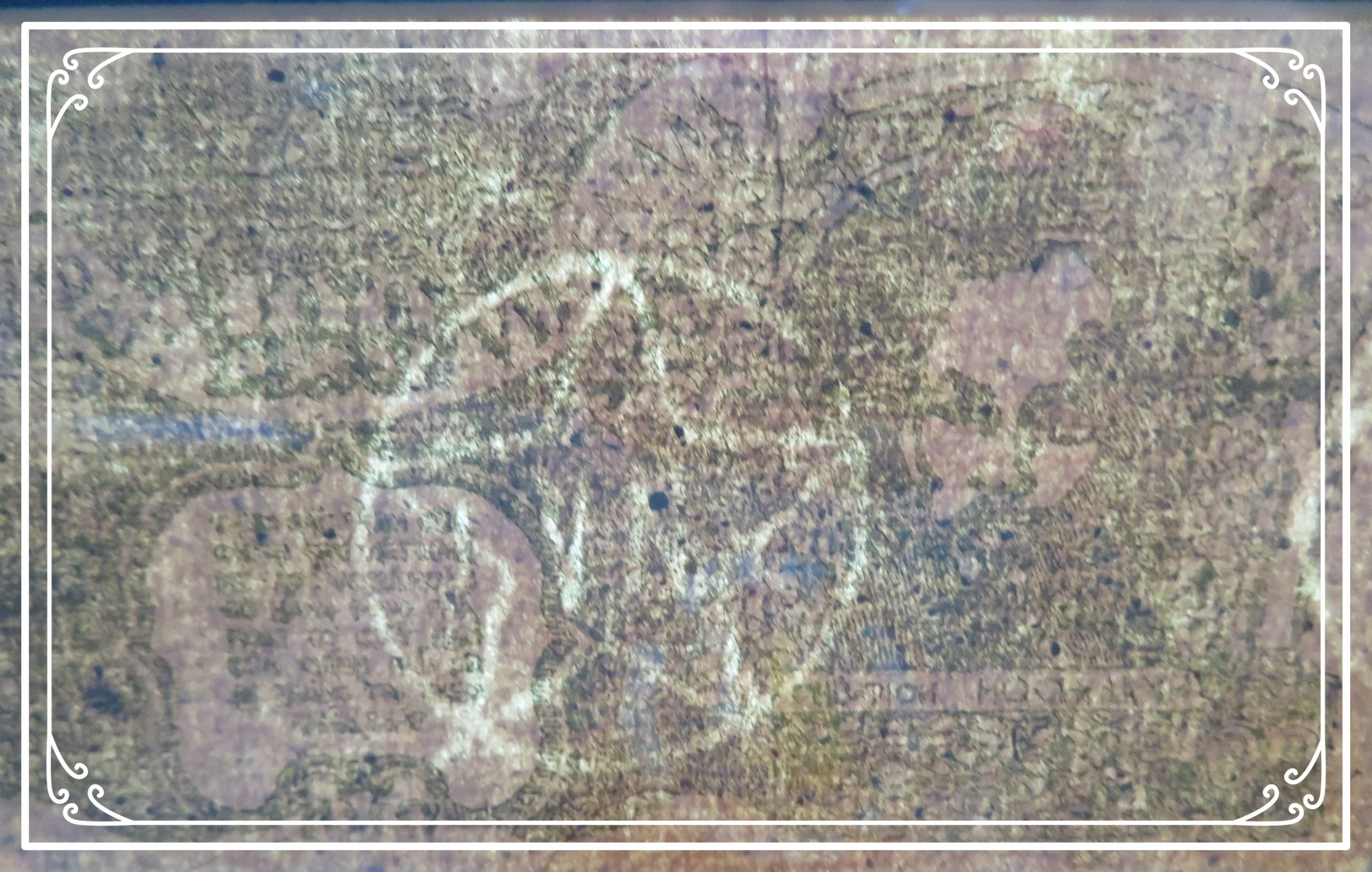
The 100-dong note, a cool little piece acquired in a Hanoi art gallery, was created by the State of Vietnam in 1949 at the start of the first Indo China war. Bearing the likeness of Ho Chi Minh and even crude but official watermarks, the currency displaced the French Union's Indochinese piastre, Vietnam's nod to The Benjamins. the people on the money being the people with the power. Five years later the Viets beat the French and booted them out at Dien Bien Phu, which has me wondering where we'll be in five years. To this day Uncle Ho is on the dong, the biggest player in Vietnam’s liberation and a hero country-wide. His gaze from my office walls reminds me of the spirit of this place, the spirit of the underdog, the spirit of upholding the warrior’s promise, even in the face of death, and the wisdom that only comes to those who refuse to quite until they've overcome all obstacles.